
-

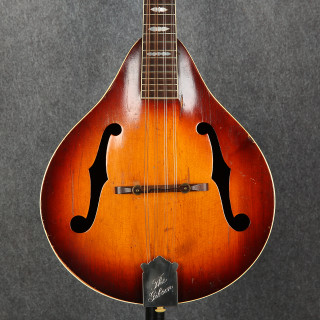
Gibson A-50 Mandolin - 1954 - Sunburst - 2nd Hand
Out of Stock -

Gibson A3 Mandolin White Face - 1919 - 2nd Hand
Out of Stock -
-

Gibson EH100 Lap Steel 1939 - 2nd Hand
Out of Stock
Gibson
Explore used Gibson bluegrass and folk instruments, including carved A-style mandolins, F-style designs and historic Electric Hawaiian lap steels. These instruments connect Orville Gibson’s 1890s mandolin innovations with the F-5’s bluegrass legacy and Gibson’s earliest amplified string instruments.
THE RICH TONE BUYING GUIDE
Used Gibson bluegrass and folk instruments: mandolins and lap steels
Gibson’s story began with carved mandolins, decades before the company became synonymous with electric guitars. Used Gibson folk instruments can span early Style A mandolins, later A-50 examples, F-style designs shaped by Lloyd Loar’s innovations and pre-war electric lap steels, making this category a window into some of the brand’s most important formative ideas.
Style A mandolins
Gibson’s teardrop-shaped Style A family puts the focus on a compact carved body and direct, balanced response. Historic examples include decorated A-3 instruments and later A-50 models, but appointments and construction evolved across decades, so each model and production period has its own identity.
F-style mandolins
F-style Gibson mandolins add the familiar scroll body outline associated with the F-5. Lloyd Loar’s 1923 F-5 introduced influential features including f-holes, a longer neck position, revised bracing and a raised fingerboard extension, helping define the powerful, articulate voice that became central to bluegrass.
A-50 and A-3 in the used market
The A-50 and A-3 show two different sides of Gibson’s A-style tradition. The A-3 belongs to the ornate early catalogue, while the A-50 name appears on later instruments with a plainer working-musician character. Used examples from different years should be understood as period-specific instruments rather than one fixed modern specification.
Electric Hawaiian lap steels
Gibson was also active at the beginning of amplified Hawaiian guitar. Its Electric Hawaiian instruments arrived in the mid-1930s alongside dedicated amplifiers, and models such as the EH-100 and EH-150 connect the bluegrass and folk archive with the earliest years of commercially amplified string instruments.
Carved-top origins
Orville Gibson began making instruments in Kalamazoo in the 1890s and patented a carved mandolin design that treated the top and back more like a violin than a bowl-back instrument. The Gibson Mandolin-Guitar Manufacturing Company was incorporated in 1902, establishing mandolins at the heart of the brand’s earliest success.
Choose by voice and playing role
A-style mandolins offer a straightforward body shape and are a natural choice for rhythm, melody and ensemble playing. F-style instruments add the visual flourish and bluegrass heritage of the F-5 lineage. Lap steels are played horizontally with a steel bar, producing sustained notes and smooth pitch movement for country, Hawaiian and roots textures.
Sell Your Gear
Sell Your Gear to Rich Tone Music or part exchange a vintage mandolin or lap steel towards your next instrument. Keeping historic Gibson instruments in use helps their distinctive voices and craftsmanship reach another generation of players.
Gibson folk instrument questions answered
Why are mandolins central to Gibson history?
Orville Gibson built carved mandolins before the company was incorporated in 1902. His carved-top approach helped move American mandolin design away from traditional bowl-back construction and established the foundation of the Gibson brand.
What is the difference between Gibson A-style and F-style mandolins?
A-style instruments use a simpler teardrop outline, while F-style models add a scroll body shape. The celebrated F-5 also introduced structural ideas such as f-holes, revised bracing and a longer neck position; exact details still vary by model and year.
What made the 1923 Gibson F-5 influential?
Lloyd Loar’s F-5 combined f-holes, a repositioned bridge, redesigned bracing and a raised fingerboard extension. Those changes supported the projection and articulation that later made the model a defining reference for bluegrass mandolin sound.
What is a Gibson EH lap steel?
EH stands for Electric Hawaiian. Gibson introduced electric Hawaiian instruments in the 1930s as part of the first generation of amplified string instruments, designed to be played horizontally with a steel bar rather than fretted like a conventional guitar.